
Cenozoix Compressor Vintage Emulations
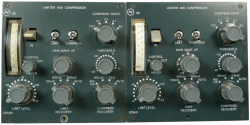
With thanks to Chris Bolte, I discovered the Cenozoix compressor plug-in, which includes 12 vintage analogue emulations. Three-Body Technologies, makers of the plug-in, seemingly did not pay the companies who’s vintage products they emulated. It’s likely they didn’t want to identify the hardware that they were trying to replace for fear of being sued. That’s fair, but I wanted to know! So I did a some digging. I also wanted to learn more about the different kinds of compressor sounds that have been used in the past, including all of those non-linear transfer curves.

Someone may ask: how close did they get to the analogue boxes? Some folks suggest they did it well, while others complain that the differences between the 12 styles are pretty subtle. I say: listen to the online demos and decide for yourself. I liked them enough to purchase. But what I’d like to do here instead, is list my best guesses at what gear they are trying to mimic, and leave your quality evaluations for you. Plus, this is a great opportunity to celebrate the aural qualities that we have inherited from the analogue gear that preceded digital plug-ins.
Brit VCA: SSL Channel compressor. The 4000 E had a punchy, aggressive channel compressor. It employed a VCA for feedforward detection with RMS. The Revision 4 dynamics added the “over-easy” soft knee, and a logarithmic release curve. The 4000 G series sounded tighter, and more focused. The Cenozoix manual uses the words “tight” and “punchy” which makes me think it is emulating the G series channel compressor. The physical console compressor had three knobs: ratio (1:1 to infinite:1), threshold (+10 to -20), and release (.1 to 4). The attack was adaptive, in a range of 3–30ms. Employing the “Fast” button fixed the attack at 3ms, and independently seemed to increase the amount of gain reduction applied.
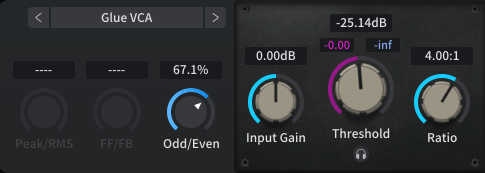
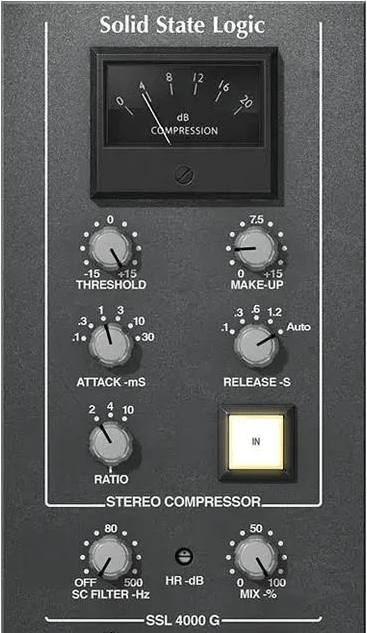
Glue VCA: SSL Bus compressor. Solid, tight, and hyped. Apparently the 4000 bus compressor sounded consistent across the series, from B to G. And according to the 9000 J series manual, that bus compressor “…is identical to the design used in the G Series range.” It incorporated peak detection and a sidechain VCA within a feedback loop. On the original hardware, the knee point of the compressor, set with the threshold control, purposely changed depending on the setting of the ratio control. Decreasing the ratio setting also lowered the effective threshold, maintaining the perceived ‘loudness’ of the compressed signal. One version of the original hardware compressor had seven adjustments: threshold (-15 to +15), makeup (0 to +15), attack (.1, .3, 1, 3, 10, 30 in msec), release (.1, .3, .6, 1.2, and auto in sec), ratio (2, 4, 10), sidechain filter (off to 500Hz), and mix (0–100%).
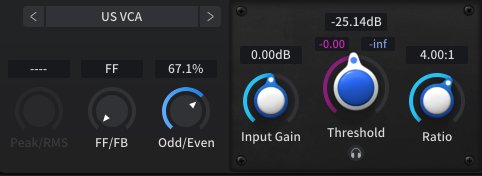
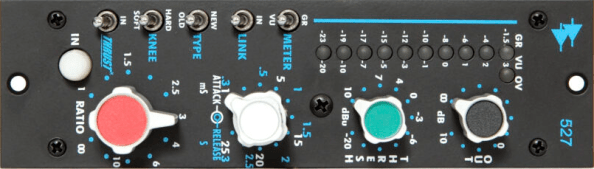
US VCA: API 527, or similar. Clean, bright, and punchy. The original hardware had a “THRUST” control that applied a high-pass filter to the detector at roughly 3dB/octave below 1kHz, though the user manual seems to indicate this continues all the way up the audible spectrum as an inverse of the pink noise shape to evenly distribute spectrum feeding the detector. The “TYPE” selector could employ feed back detection, which was peak detecting, and was described as smoother, softer, and more transparent. When selected feed forward, which was RMS detecting, this option was described as more aggressive compression and a harder, more affected sound. The knee selector allowed for a SOFT, “over easy” style transition into the ratio. The threshold was continuously variable from +10 to -20. The attack was continuously variable between 1 and 25 ms. The release was continuously variable between .3 and 3 seconds. Ratio was continuously variable between 1:1 and infinity:1.
Black VCA: dbx 160. The very first dynamics controller with a Voltage Controlled Amplifier (VCA), the revolutionary gain reduction device with a linear transfer curve. The detector is RMS. The original hardware had three controls: threshold (10 to -20), compression (ratio, from 1.5:1 to infinite:1), and output gain (-10 to +20). The original 160 did NOT have an Over Easy, soft knee option, which was added in later models such as the dbx 165.
Red VCA: Focusrite Red 3. Clean, transparent, and warm. A peak detecting VCA compressor (not RMS). The hardware has a ratio selector for 1.5, 2, 3, 5, 7, and 10:1. The attack times from .3 to 90 ms, and release times from 100 ms to 4 seconds are both continuously adjustable. There’s also a little yellow button for an auto-release option. The threshold can be set from -24 to +12 dB.
Johan Englund made the point on Airwiggles that this probably isn’t an emulation of the MXR Dyna Comp, which was my first guess. I was fascinated by this red stomp box for use with an electric guitar, which has knobs that look a lot like what’s shown in the Cenozoix interface. The MXR intentionally colors the sound, adding a sheen on top, and thinning the low end. Sweet guitar sustain, with single notes that bloom & soar, and popping, ringing clean chords. The hardware had two controls: output, and sensitivity. Squishy, with a fast attack (5 ms), and long release (1 sec). The ratio is estimated to be 10:1.
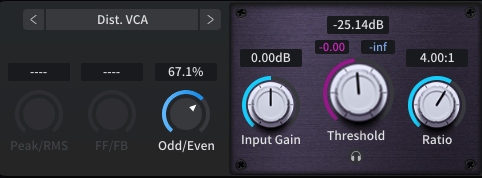
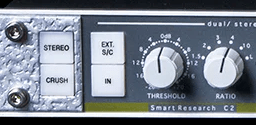
Dist. VCA: Smart Research C2. Tight, thick, and huge. The original hardware combined a clean VCA path with a “Crush” FET gain control stage for an overcompressed sound, that also added a high frequency lift, which has been described as airy, or glossy. Ratios: 1.5, 2, 3, 4, 10:1, and Limit. Attack: 0, 0.1, 0.3, 1, 3, 10, and 30 ms. Release: 0.1, 0.3, 0.6, 1.2, and 2.4 seconds.
Black FET: Universal Audio 1176LN, black. Of all the compressors that can be described as punchy, this is arguably the most punchy. It manages to knock down the loud parts without sounding flat, or lifeless. It is a feedback peak detecting compressor, which slows the response. The original hardware had four knobs: input, output, attack (0.02 to 0.8 ms), and release (50 ms to 1.1 sec). And there were ratio selectors for 4:1, 8:1, 12:1, and 20:1. You could press all of the ratio buttons for an even more extreme sound.
Blue FET: Universal Audio 1176 Revision A, silver with blue. This represents the first version of the compressor, with more harmonic distortion, aggressive sounding upper mids, and classic “vintage warmth.” Depending on the source material, the prominent upper midrange and increased harmonic distortion can produce results that sound even punchier than the 1176LN with black faceplate.
Vintage Opto: Teletronix LA-2A Leveler. Smooth, gentle, transparent, and full-bodied. The original tube-driven (warm sounding) compressor features an electro-optical attenuator, with a non-linear transfer curve that knocks down loud parts while still sounding dynamic. The detector is RMS. The original hardware had two control knobs: gain, and peak reduction. The attack time is .01 ms! The release time varies from 0.5 to 5 sec. Some hardware versions included a switch to compress or limit, with compression using a ratio estimated at 3:1, and limiting estimated at 10:1. Gain reduction maxed at 40dB.
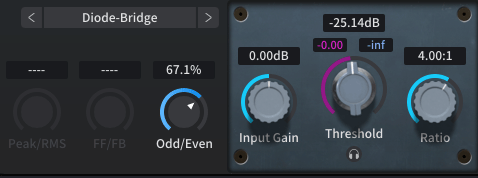
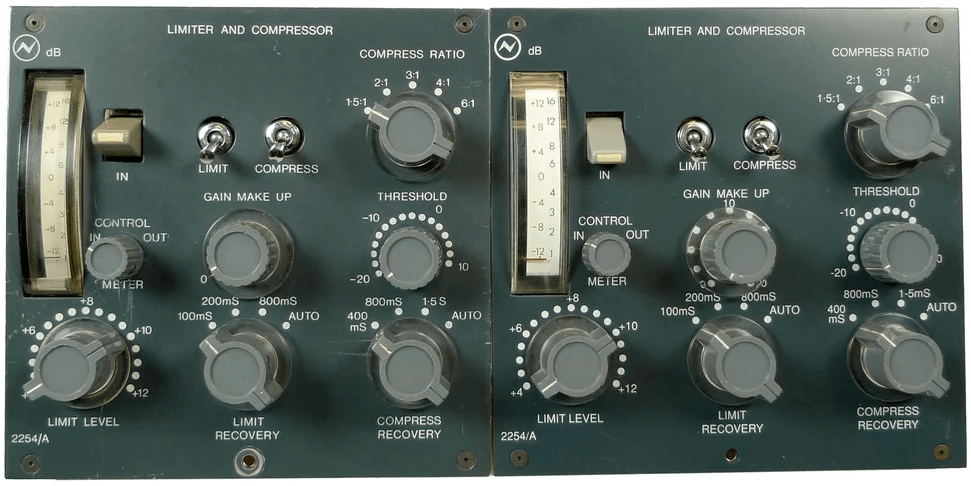
Diode-Bridge: Neve 2252, 2253, 2254. Smooth, silky, and sweet sounding, with purpose built transformers contributing to the color. A peak detecting dynamics controller with separate limiting and compressing capabilities. The 2254R has adjustable “fast” attack limiter times from .1 to 2 ms, while the standard attack time is 5 ms. Distortion is more likely with faster attack times, especially under 1 ms. The limiter release times are: 100, 200, 800 ms, or “AUTO”. The compressor ratio selector offers: 1.5, 2, 3, 4, and 6:1. The compressor release times are: 400, 800 ms, and 1.5 sec, plus an “AUTO” mode.
Virtual-Mu: Altec 436, Altec 438, and/or Altec RS 124. Smooth and warm; a gentle, vintage compressor. Originally designed for use on voice in public address systems. The heavily modified RS 124 was used extensively on Beatles recordings. This variable-mu tube compressor has a ratio that starts at 2:1, and gets steeper as the threshold is raised, maxing at 4:1 with a threshold of +16dB. It has a fixed attack time of 50 ms. The 436C has a release adjustment (.3 to 1.3 sec). It offered maximum compression of 30dB.
Vintage Tube: Fairchild 660, 670. A warm sounding variable-mu tube compressor. Attack and release times were tied into a single control called Time Constant, with six positions: 1. attack 0.2 ms/300 ms, 2. 0.2 ms/800 ms, 3. 0.4 ms/2 sec, 4. 0.2 ms/5 sec, 5. 0.4 ms/2–10 sec, and 6. 0.2 ms/10–25 sec! The compression ratio was tied to the threshold, “A 2 to 1 ratio as a compressor with a threshold 5 dB below average level, and a peak limiter with a 30 to 1 ratio with a threshold 10 dB above normal program level.”
Let me give a quick shoutout to the two sources I most often used to collect information about these vintage hardware compressors: Sound On Sound, and Vintage Digital.
So, if you’re looking for a dynamics plug-in to get the kinds of sounds that these analogue compressors could render, have a listen to the demos to decide if the Cenozoix Compressor might be what you need. As a long time fan of the 1176LN, I reach for the Black FET option frequently. And if you want to check the Cenozoix manual for clues (that’s what I did), see pages 21–24 (PDF pages 24–27), and share your opinions about what they are emulating in the comments.
Three-Body Technologies were kind enough to share with me that the RMS window size for Cenozoix is 40 ms.
Options Slate Digital offers a huge line of vintage emulations. I’m a big fan of the McDSP 6030 Ultimate Compressor with ten compressor modules in a single interface, eight of which are vintage emulations, and two of which are kind of gap fillers, imagining what vintage compressors might sound like across a range. FabFilter C3 offers Style options for optical (2 varieties), variable-mu, and feedback detection, as well as Character options to drive harmonic distortions that mimic tube and diode hardware. Please drop your vintage emulation plug-in favorites in the comments.
 Randy Coppinger
Leave a comment