
Baffled Omni Microphones, Modifying Jecklin Disk
When Les Paul invented the electric guitar, he probably never imagined how Jimi Hendrix would repurpose it. I think it’s fun to take someone’s original idea, and morph it into something different.
While Jürg Jeklin was at the Swiss Broadcasting Corporation, he designed what he called the Optimal Stereo Signal technique. It’s colloquially known as “Jecklin Disk.” Here are some details from Streicher & Everest in The New Stereo Soundbook.
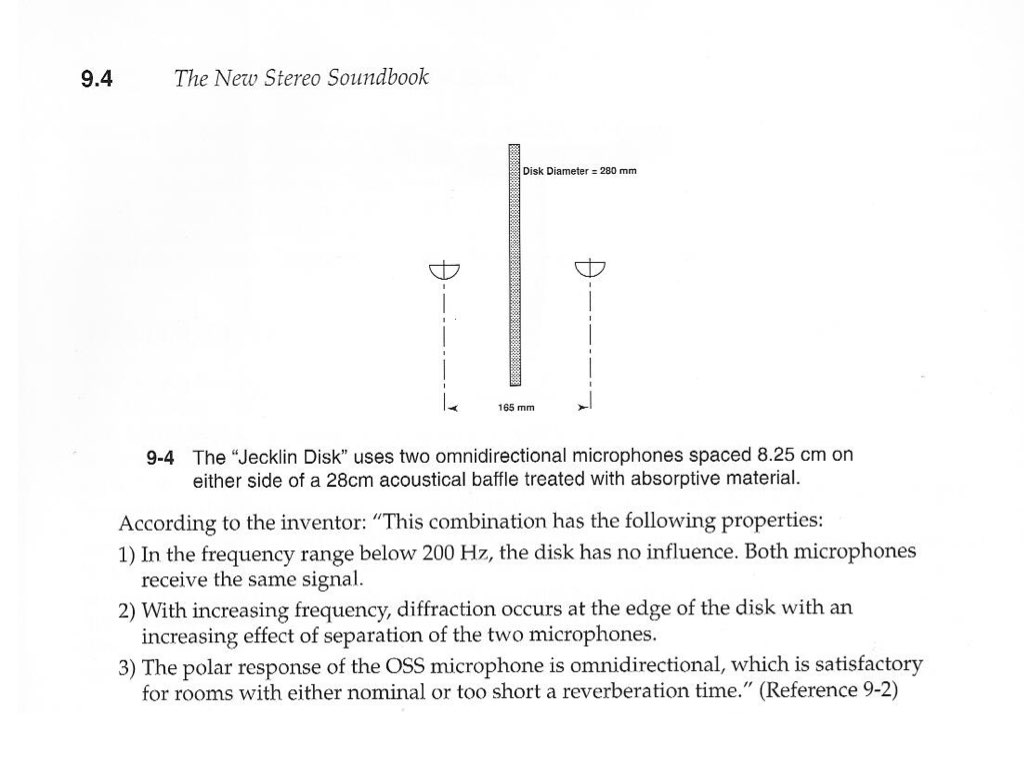
Jecklin seemed to have in mind properties of a binaural head, but seeking a microphone configuration that could sound equally good on speakers as in headphones. I suspect this array was intended for use in the free field, meaning at a distance, to pick up naturally occurring reflections. By contrast, I came to this technique wanting to record some things in stereo at only a few cm distance from the capsules.
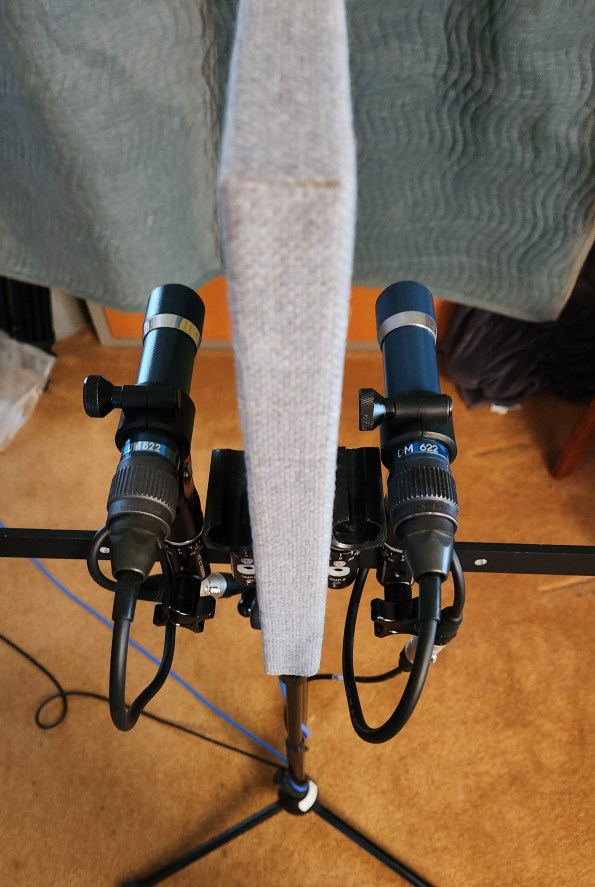
I started with an AB omni pair. At the suggestion of a friend, I experimented with adding a fiberglass baffle to improve separation between the omni microphones.
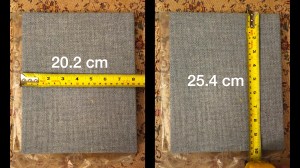
Technically, the array I built was not Jecklin Disk. My baffle was smaller, and not round. My microphones were closer together at 10 cm, Jecklin is 16.5 cm. I just adapted the idea of using an acoustical baffle for my specific situation to improve the stereo image of a spaced pair of omni microphones.
 Randy Coppinger
Leave a comment