
I was going through projects and found djembe recordings that my friend Austin Farmer and I made a while back. Djembe is one of my favorite percussion instruments, and we found microphone choices that were too good to keep archived.
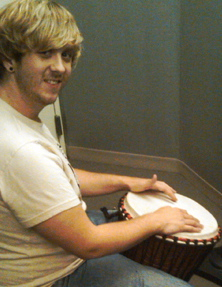 I was taught to record djembe from above, much the way one records congas or tom toms. That mic was placed 16 inches (41cm) from the center of the drum with the mic near the outer edge pointing across to the center. There is a lot of bass that resonates out from the bottom of the drum so another mic was placed under, 8 inches (20cm) from the bottom rim. To help decouple the djembe from the floor and give a bit of clearance for a mic underneath, we set the djembe on four pieces of foam. It worked pretty well. Austin and I decided that he would hit the center of the drum and let the low fundamental (71 Hz) ring out. Then hit the edge of the drum where it sounds higher and let that ring out. And finally play a pattern of center and edge to hear everything together. Whenever there are fast transients I consider using analog compression before the AD converter. But for this shootout, I also wanted to be able to hear each mic raw. Luckily the Martech MSS-10 mic preamps I used had two sets of outputs. I routed through compressors and directly to the 192 IO at the same time and recorded all four tracks.
Let’s start with the Audio Technica AT 4050 above and the AT 4047 underneath. We first hear each mic individually without compression, then a mix of both microphones including the analog compression.
The 4050 is one of my all-time favorite under $1,000 condenser microphones. It’s a fantastic general purpose mic and we hear how great it sounds on djembe. I love the overhead detail that lets us hear the snap of hand against drum head with that nice, full bass.
The Audio Technica AT 4047 is another cost effective mic and a great utility piece that can add some nice “color.” Compared to the 4050 the bass is much tighter and there is less detail in the high frequencies. Because it sounds dark, I expected more from the 4047 as the bottom mic. The mix of 4050 with 4047 was good, but I suspect the overall mix would have been even better with a 421 underneath instead.
For comparison, let’s have a listen to the discontinued AKG C-451 EB with CK-1 capsule and the Sennheiser MD 421.
I loved how articulate and tasty the 451 sounded. It seemed like I could hear each part of the hand hit the drum skin separately. But all of that detail forced me to watch my levels closely. I was especially impressed with the bass response… full and rich sounding djembe even without a mic underneath. I’m told the AKG re-issue of this mic — the 451 B — doesn’t hold a candle to the original. I love my 451 EB with the cardioid CK-1 capsule for percussion and this recording is proof that it’s a great choice for djembe.
My studio mentors used a 421 underneath djembe. And no wonder: it sounds great in this application. Despite the crazy irregularities in the pickup pattern (or maybe because of it) the low end really rings out nicely. This microphone can handle SIGNIFICANT sound pressure, so I have no reluctance shoving it up inside the drum. I think it would sound even better with a different mic placement than I used here. This confirms 421 as my first choice mic under djembe.
The Signal Path
 Top mic > Martech MSS-10 > 192 IO analog in 1
Bottom mic > Martech MSS-10 > 192 IO analog in 2
Top mic > Martech MSS-10 > Purple MC77 > 192 IO analog in 3
Bottom mic > Martech MSS-10 > Summit DCL-200 > 192 IO analog in 4
Why bother with analog compression?
(1) Some argue that the finest details of fast transients are diminished in the process of digital conversion, so really quick analog compressors get better results when used before digitization, and (2) I like to present the AD converter with an “optimized” sound (similar to how engineers used to record to tape) because it gives the converter the best opportunity to capture the essence of what I’m recording.
Explore Audio Technica, AKG, and Sennheiser microphones.
Other microphone comparisons:
Neumann vs Gefell
Neumann vs Studio Projects
Got a pinboard for articles like this? 

I’m so fortunate to work with talented folks like Cassandra Morris, Stephanie Sheh, and Tara Platt. It’s not surprising how well recording sessions go with good actors on the sound stage. And as you can tell from the pictures, we didn’t have any fun during these sessions at Skylark Sound.
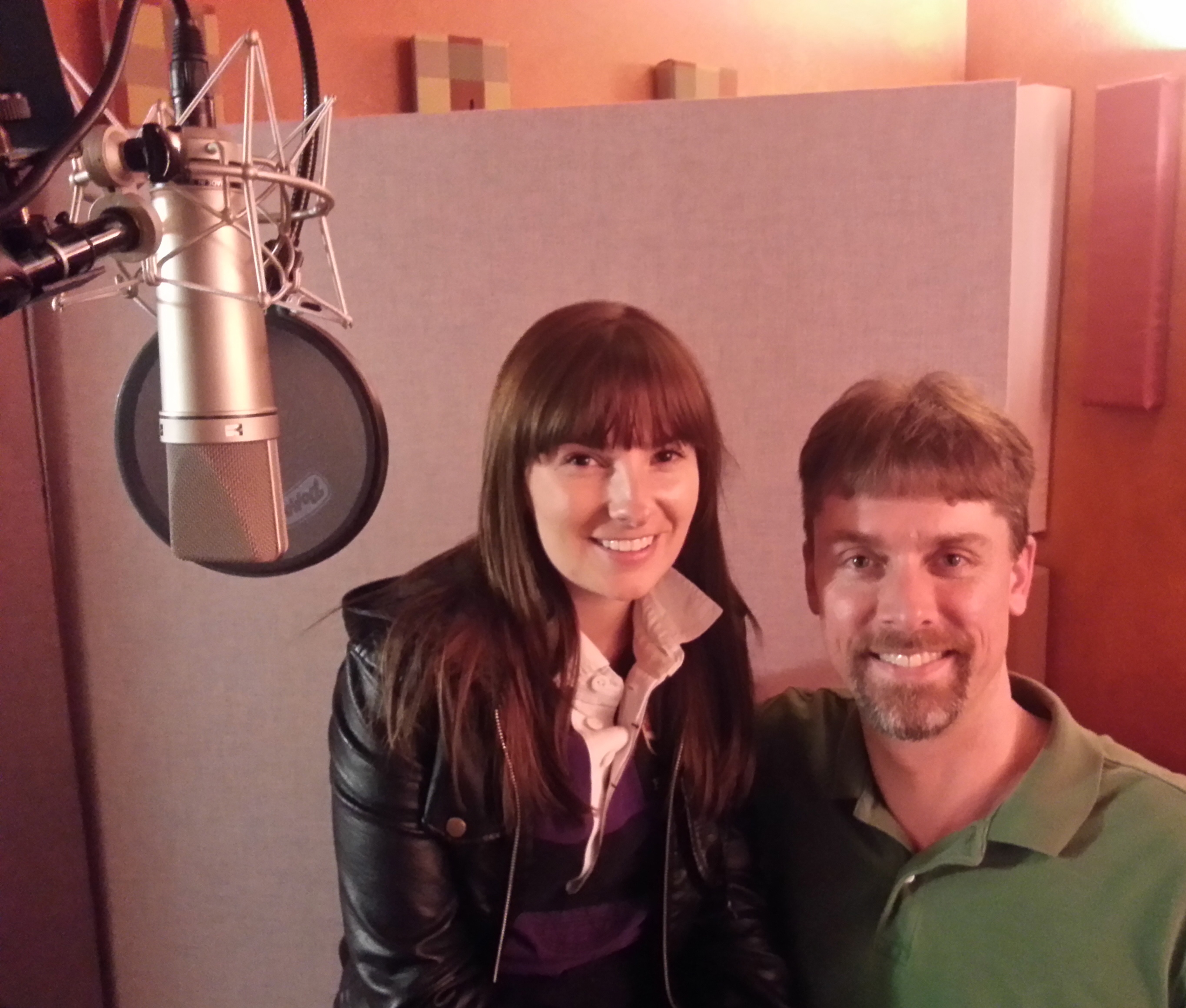
At the mic with Cassandra Morris [imdb]
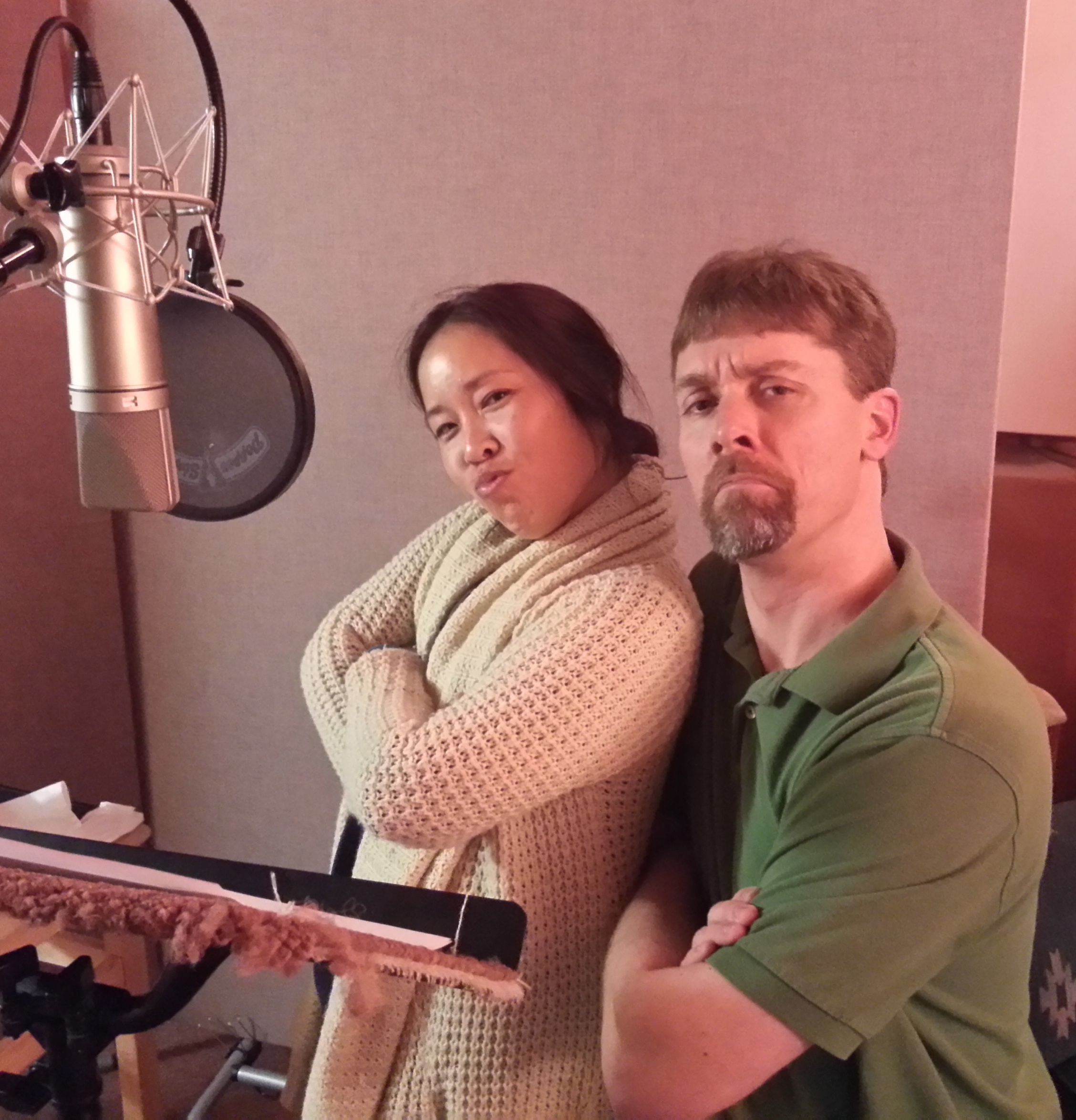
At the mic with Stephanie Sheh [imdb]
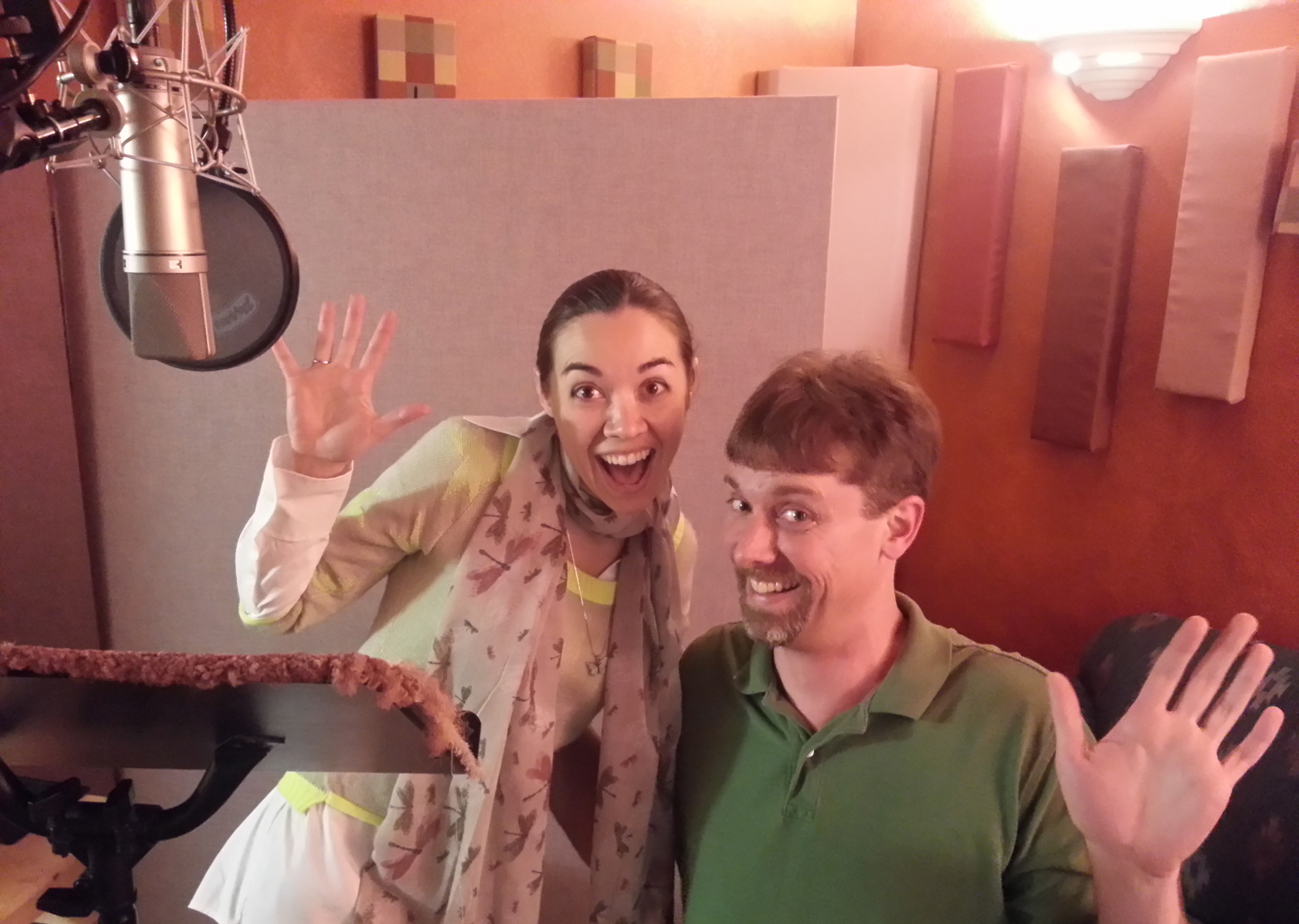
At the mic with Tara Platt [imdb]
More pics with actors in the studio.
A pin board of voice actors.

UPDATED: June 2020
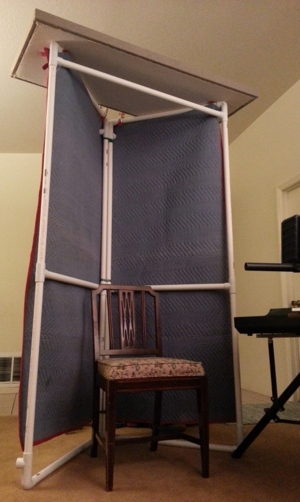
It started as a simple idea: what’s an effective way to improve location recording acoustics with low cost materials? Since I already owned some packing blankets and absorptive panels, all I really needed was a method to prop them up effectively. And everything needed to collapse into relatively small pieces to fit inside my Camry.
I decided to focus on the packing blankets, with a support structure made of PVC pipe – the kind used for delivering water in houses, for irrigation, etc. I thought it might be handy to have the ability to hang one blanket on the structure, or configure a larger version that could hold two blankets. Over the weekend I spent roughly $60 on PVC & hand clamps then went to work.
The first pic shows the smaller, single blanket “L” configuration. I laid a panel on top to see how it might function as a lid. This single blanket likely doesn’t have enough coverage to significantly contain a performer and provide much separation from other sound sources. But it might be useful to cut down reflections behind a performer.
The larger, two blanket “C” configuration shown below would significantly deaden a recording situation, especially with a third blanket on top as shown. I’d like to reduce the sag of the top blanket with some additional structure up there. The blankets are heavy enough (have enough mass) that they would also provide some isolation from other sound sources in the same room. This larger version seriously limits sight lines though, so I’m considering clear vinyl sheets (as used for some shower curtains) to create small windows.
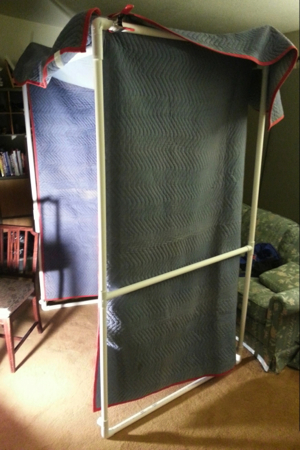
It’s worth noting both configurations can open up if the top-front support pipe is removed. Wider angles form more of a wall/curtain than an enclosed booth. I can also imagine making a few more of these that could work together in a modular fashion, further expanding options.
This is a solid beginning to affordable, portable acoustical tools that are easy to transport. With some more work, improvements may be discovered. I hope this inspires you to take a do it yourself approach to acoustics and recording. And here’s a pro tip if you decide to work with PVC: a handheld pipe cutter tool is far superior to a hacksaw.
Check out Dee Bradley Baker’s use of PVC to support heavy sound blankets inside a closet- Building a home studio in a closet
There is an Ampex 3001 microphone in the collection of The Museum of Modern Art in New York! The microphone element was made by Shure, but the overall industrial design of the mic was created by American artist Terrance Nelson Taylor. It’s certainly one of the more stylish microphones made in the 1960s.
The Ampex Model 985 reel-to-reel tape machine came stock with a pair of 1101 microphones. The 3001 seems to have been a microphone upgrade option. Both the tape machine mic input and the 3001 output are unbalanced. The sound is undeniably Shure Unidyne, of which I happen to be a big fan. But it seems to be transformerless, which opens up some new sonic options depending on how you interface it. It’s great for any source where you might use an sm57 but with the tweak-ability (and, admittedly burden) of choosing the kind of interface the element pushes into, transformer or otherwise.
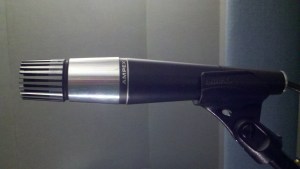
It’s been a fun microphone picture series. Thanks to everyone for following, participating, and encouraging.
Follow this WordPress blog, or via Twitter or Facebook for more microphone related posts, and general pro audio geekiness.
Index to the whole Name That Mic series.
Alexander Brandon asked,
 What are rates like for editing for games compared to film/TV?
The upper tiers of film and television jobs offer compensation based on a half century of labor agreements and precedent, to some amazing veterans of entertainment. Game audio is still developing by comparison, so there are fewer standards for pay and fewer long-time experts commanding high-end compensation. But you can find horrible pay at the lower end of any of these media industries without looking very far.
Listen to other questions and answers… Dialog Editing for Game Audio.
Our final microphone in the series is moving coil with a cardioid pattern. The element was made by a prominent US microphone manufacturer but sold as part of a tape recording machine with the name of machine’s manufacturer on the mic (obscured in this pic). The input on the tape machine was unbalanced, thus the mic output was also unbalanced. Do you know this microphone?
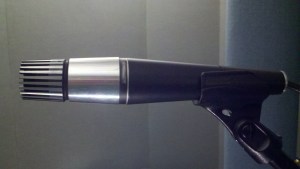
Follow this WordPress blog, or via Twitter or Facebook to find out if you were right, and try to guess all of the microphones in this series.
Index to the whole Name That Mic series.
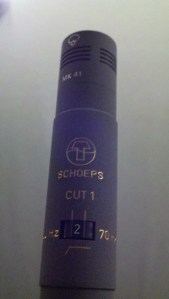
The Schoeps CMC 6 modular series are known for their accuracy, both in frequency response and consistency of polar pattern. The mic pictured is known as the CMC 641: the CMC 6 mic preamp body with an MK41 supercardioid capsule on the end.
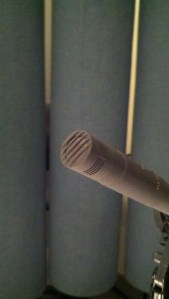
In other views we can see the optional CUT 1 variable low rolloff.
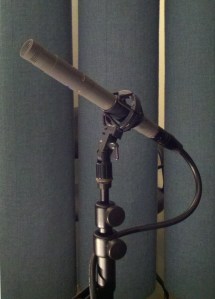
I love this mic for location sound, ADR, stereo arrays… just about anywhere a nearly perfect supercardioid, uncolored microphone would be useful. The rolloff helps compensate for proximity effect, which tends to be noticeable. No, Schoeps microphones are not cheap. But they sound great and are useful in so many different recording situations, that the cost may be justifiable.
Follow this WordPress blog, or via Twitter or Facebook to to guess all of the microphones in this series.
Explore Schoeps Microphones (English).
Index to the whole Name That Mic series.
How about a small diaphragm condenser? This microphone is modular, so there are many possibilities. This one happens to have a supercardioid capsule on it. Can you name it?
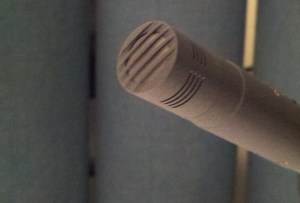
Follow this WordPress blog, or via Twitter or Facebook to find out if you were right, and try to guess all of the microphones in this series.
To be honest, this mic is a bit of a mystery to me. It’s definitely omni, with no proximity effect, which is probably one of the reasons why harmonica players like this microphone for cupped, handeld playing style. It has a peculiar frequency response. Check out the graph-
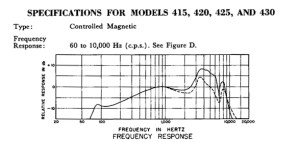
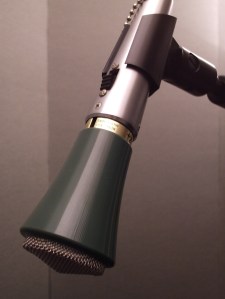
After pouring over the literature, I believe this mic is a Shure 430, part of the 400 series of “Commando” mikes, so named for their durability and green finish. The operating principle is described as Controlled Magnetic, which might be moving coil, but I’m not certain.
In addition to harmonica, I like this mic for re-amping, as a room mic, or anytime we want something to sound really different. Plus it looks retro cool, which has nothing to do with the way it sounds, but might inspire a great performance.
Follow this WordPress blog, or via Twitter or Facebook to to guess all of the microphones in this series.
The giant list of discontinued Shure microphones is like a walk through time.
Index to the whole Name That Mic series.
The distinctive look of this microphone ought to give it away for anyone who has used one. The mic was made by a US manufacturer based in the middle of the country. The pattern is omnidirectional. The mic was sold unbalanced, though there was a kit available to balance it.
Follow this WordPress blog, or via Twitter or Facebook to find out if you were right, and try to guess all of the microphones in this series.
 Randy Coppinger