
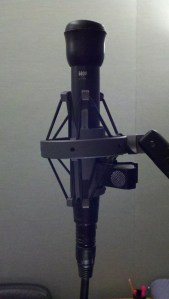
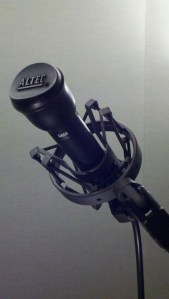
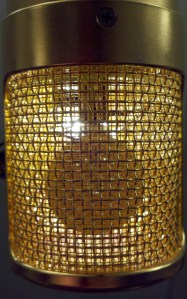
The Altec 680A moving coil microphone is omnidirectional. It sounded great when I spoke into it for Episode 179 of the Home Recording Show. Sound enters through a 2 mil channel behind the head of the mic. This narrow passage supposedly creates an “Acoustic Gate” that eliminates high frequency peaks. And because it’s an omni, there is no proximity effect and — according to the literature — there is no wind noise. I’ve not thoroughly tested these claims, but it makes a cool room mic for loud sound sources.
Click any image to enlarge
Follow this WordPress blog, or via Twitter or Facebook to to guess all of the microphones in this series.
Index to the whole Name That Mic series.
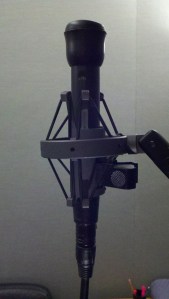
Time for another moving coil microphone. This one is balanced and the polar pattern is omni. If you’re a fan of the Home Recording Show, you may have heard me speak into this mic.
Follow this WordPress blog, or via Twitter or Facebook to find out if you were right, and try to guess all of the microphones in this series.
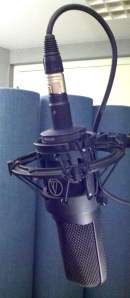
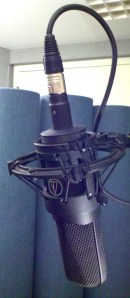
You may have guessed from the logo that the mic is made by Audio Technical, or by the body style that this is from the 4000 series. But if you guessed 4033 you were wrong. The key difference in the photo is the length of the grill, longer than any of the other mono mikes in the 4000 series. The mic pictured is the tube AT 4060. Another detail that differentiates this mic from others in the 4000 series — as noted by Jon Tidey — is the thumb screw mounts. The 4060 has a particular sound: lots of girth and glassy top end. It seems like the designers were trying for something reminiscent of a C12. I like the 4060 when someone needs to sound extra manly, or larger than life (think monster voices). It sounds great on electric guitar cabinet too.
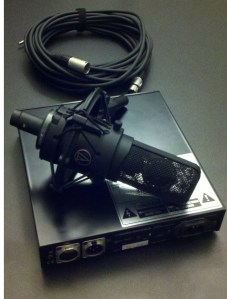
Click any image to enlarge
I used the 4060 on guitar cabinet for most of the Stardust Ramblers songs. Have a listen on my music demo page.
Follow this WordPress blog, or via Twitter or Facebook to to guess all of the microphones in this series.
Explore Audio Technica microphones (English).
Index to the whole Name That Mic series.
People argue about whether attempts to recreate the famous Neumann u47 tube mic sound like the original or not. When it comes to the Lawson L47, I don’t really care. This is an all time favorite microphone for recording voice. Some alto voiced females sound a little stuffy or chesty on the L47, but otherwise it’s a slam dunk on actors and singers. I especially appreciate this mic with sibilant voices, which are magically tamed. It’s great for recording things other than voice too. The continuously variable pattern adds versatility to the mic.
The gold finish seems to draw scorn or adoration. But you can order in silver, if you prefer. The gold bling certainly invites some glamour shots…
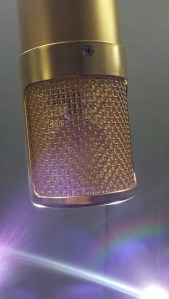
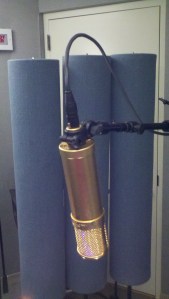
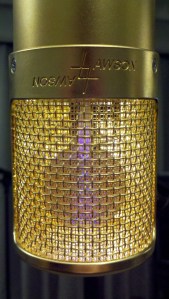
If you notice a hint of blue near the capsule, it’s not just lens flare. There is a blue LED inside the wire mesh that illuminates then you set a switch on the mic body to fixed cardioid. In the other switch position the LED shuts off and the continuously variable pattern selector is active.
Follow this WordPress blog, or via Twitter or Facebook to to guess all of the microphones in this series.
Explore Lawson Microphones.
Index to the whole Name That Mic series.
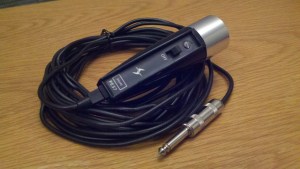
The Shure PE57 is far from glamorous. It’s downright ugly with no top end, no bass… it’s not even terribly present. But what it lacks in fidelity is makes up with funk. When you want something to honk, this microphone has a wooly midrange you can’t ignore. I think of microphones as different colors for sonic painting, which makes unique ones valuable. It would be difficult to mistake something recorded with this microphone for anything else. I most commonly use my PE57 for re-amping or as an ambient room mic.
Click to enlarge
Follow this WordPress blog, or via Twitter or Facebook to to guess all of the microphones in this series.
Index to the whole Name That Mic series.
Here’s an inexpensive, unbalanced moving coil microphone I bought used. As with many previous pics, the make and model have been obscured but I haven’t removed every clue. If you don’t know this one, take a guess.

Follow this WordPress blog, or via Twitter or Facebook to find out if you were right, and try to guess all of the microphones in this series.
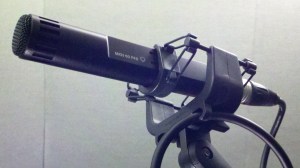
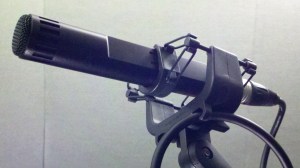
It’s the Sennheiser MKH 50, recommended to me by Doc Kane for ADR. Once you engage the low rolloff it has a very similar sound to it’s sister Sennheiser, the popular 416 used for film/TV dialog. A slight move off axis can sound comb filtered with a 416. But since the MKH 50 lacks an interference tube, it avoids the comb filtering. The supercardioid pattern holds pretty consistent across the spectrum, so off axis sounds don’t have any particular color.
Click to enlarge
Follow this WordPress blog, or via Twitter or Facebook to to guess all of the microphones in this series.
Explore Sennheiser Micrcophones (English).
Index to the whole Name That Mic series.
This time we’ve got a supercardioid end-address pencil condenser. It has a pad and low rolloff. The model number has been obscured in the pic. Do you know this one?
Follow this WordPress blog, or via Twitter or Facebook to find out if you were right, and try to guess all of the microphones in this series.
 Randy Coppinger